Tuesday, September 30, 2014

Key West Aquarium - The Island's First Tourist Attraction

Reaching into the Gulf of Mexico at the end of Whitehead Street is a uniquely interesting home to many of the local species of sea creatures. I'm talking about the Key West Aquarium, the island's first tourist attraction. As one of the top family friendly things to do in Key West, make sure it's on your itinerary. 


Built back in the 1930s, the aquarium is still a popular destination for tourists. Imagine going snorkeling or diving after your visit. You'll get to see the same creatures you learned about here, but in the wild. 

Inside the main building there are large salt-water pools with stingrays, turtles and sharks. Along the walls there are tanks filled with the fish of the Florida Keys. In them you'll see: yellowtail, grunts, clown fish, parrotfish and more. 
Out back there is an area where rescued turtles are rehabilitated before they are release back into the sea. Next to it is where the shark feeding takes place, a must see part of your experience.


While you're here, help out by feeding and petting some of the sea life on display. Reach in and pet a Cownose stingray, pet a shark or hold a starfish in your hands. Whatever you decide to do, you'll have a fun learning experience.


The Aquarium is located at 1 Whitehead Street, just behind the Key West Shipwreck Museum and next to the sponge market. Hours of operation are daily from 10-6 pm with guided tours and shark feedings at 11am, 1pm, 3pm and 4:30pm. Pricing is the same as the Key West Shipwreck Museum: Adults = $15.04, Children = $8.59 and Seniors = $12.90. If you purchase your tickets online the prices are as follows: Adults = $13.54, Children = $7.93 and Seniors = $11.61. Check them out online at www.historictours.com or www.keywestaquarium.com or you can call them at 305-296-2051.

Monday, September 15, 2014

"Wreck Ashore!" A Visit to the Key West Shipwreck Museum

"Wreck Ashore!" The cry goes out over the island. Quickly every able-bodied man rushes to his skiff and heads out to sea. There is a lot at stake. The first one to reach the wreck becomes the 'wrecking master' and gets the lion's share of the booty from the sinking ship. This was life in Key West back in the 16, 17 and 1800s.

The Key West Shipwreck Museum brings the days of the wreckers back to life. When you step inside, you are surrounded by artifacts from ships that lost their lives on the reef off the Florida Keys. Master salvager, Asa Tift greets you and walks you through what life was like back then. There are gold and silver coins, a 64 pound silver bar from Nuestra Senora de las Maravillas, old bottles, and a grand piano sits in the center of the room. Take your time looking around at all these ancient treasures.


Upstairs travel along the halls of artifacts used by and found by wreckers of the day. Read about the lives of some of the richest wreckers and see a list of all the wreckers from back then. Look closely; maybe you have an ancestor listed there.

When you're done exploring inside, step out and climb to the top of the 65' lookout tower. You can see the whole island from here. Imagine being the first one to see a shipwreck and yell out the call "Wreck Ashore!"


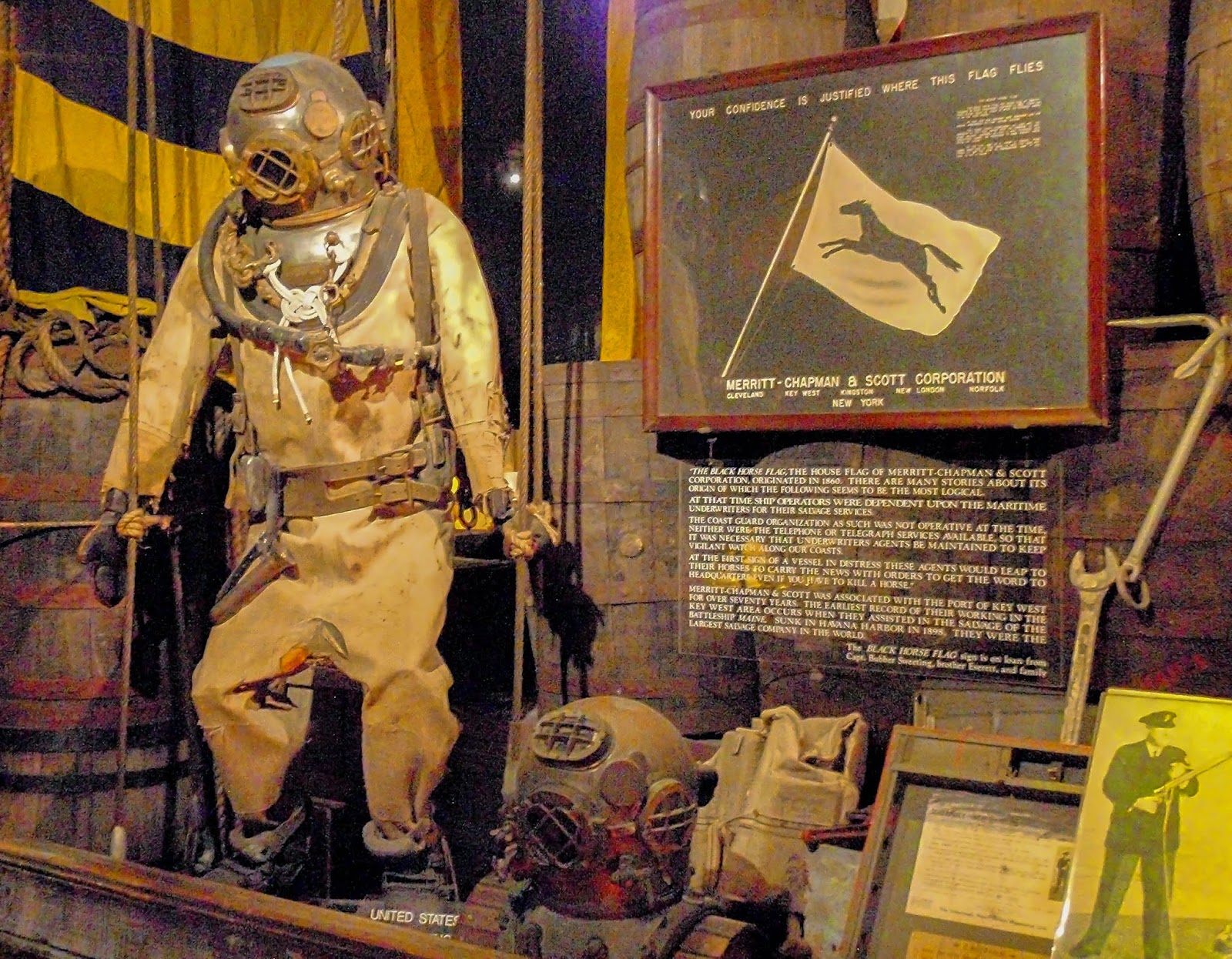
After you've walked all the way to the top of the tower, descend to the lowest level and enjoy a short film about the life of wreckers. As you get ready to leave, you'll pass by the diving gear from the past and present. Would you like to put on that heavy gear and jump in the water to salvage gold and jewels?


To visit is easy. Bring your family to 1 Whitehead Street, right in front of the Aquarium, the sponge market and Mallory Square. Hours of operation are daily from 9:40-5pm with the last show starting at 4:40pm. Pricing for here and the Aquarium are the same: Adults = $15.04, Children = $8.59 and Seniors = $12.90. If you purchase your tickets online the prices are as follows: Adults = $13.54, Children = $7.93 and Seniors = $11.61. Check them out online at http://www.historictours.com/or http://www.keywestshipwreck.com/ or you can call them at 305-292-8990. Come revisit the life of a wrecker at the Key West Shipwreck Museum.

Monday, September 8, 2014

What Do The Boots Say

A few weeks ago we went to the rodeo. A real rodeo. I took over 1,030 pictures of everything from horses, bull riders, the Junior rodeo, hats and boots. Yes, boots.


Here are some pictures of boots. Now, as you look at them, decide what the boots are saying. Each of these has a story to tell. Maybe someday I'll tell those stories, but for now, you make up your own stories. Share them in the comments here if you want to. If you do, I'll assemble them and do a post with the picture you chose and what it said to you. Have fun with this, get creative and see where it takes you. I can't wait to read what the boots said to you.

1
2
 3
4
5a
5b
6
7a
7b
8a
8b
                                
9
Have fun!

Tuesday, September 2, 2014

Horseshoe Crab Orgy

I know it's been a while since I posted. I guess life got in the way. Anyway, today I have an interesting tale for you from our travels. Sit back and enjoy, and be glad you aren't a horseshoe crab!

As I sat on a bench taking pictures of the sunset, I saw these little legs and spiky tails flailing around in the breaks of the waves. After watching for a few minutes I realized they were horseshoe crabs. As the waves started to wash them up on the beach, I noticed they were coming in pairs, a big one on the bottom and a smaller one attached to its' back. At first I thought they were mommy and baby, but soon realized they were male and female mating. I quick got my GoPro and started filming them as the female would bury herself in the sand and the male was shifting around on her back. 


So I filmed this one couple work their way through the waves and come to shore. The female started burying herself then suddenly stopped. Next thing I know she's turning around and heading back into the river. I think she got to close to this other horseshoe crab couple that she didn't like.


One more tale from that night: At the end of the beach invasion a couple was struggling in the breaking waves. Just as they were being tossed on the beach, a wave came up and flipped them on their backs! Well, the female tried and tried to flip back over. When she was almost there, the male separated from her. Now, instead of trying to help her, he took off and started to horn in on another copulating couple and abandoned her! There she was, butt stuck in the sand, tail in her face. I tell you! When she finally flipped over, she took off back into the river, as fast as she could get away from him. Here is a picture story of this. 
Couple arrives on the beach.

Trying to flip over.

She uses her tail to trip and flip.

The male is hanging on for dear life.

The male breaks free.

The male flips himself.

Now the male is checking on his mate. You think he's going to help her, right?

WRONG! He abandons her for another.

See, he's trying to horn in on this other couple.

So now he tries to steal this female from her partner.

Tuesday, August 19, 2014

A Walk Through Mexican History - The Coachella Wall

Today's post is about a work of art that really touched me. I learned from it as well as was taken in by all it's beauty. I hope it reaches into your heart and encourages you to go see it and learn more about this wonderful collaboration of artists and a city.
Enjoy!


The Coachella Wall

The black, gray, and white checkerboard design on the floor is an optical illusion. You feel like the dancers could fall through to another era. Sounds of Swing music are in the air. The couple dances the night away. He's dressed in a canary yellow zoot suit and matching yellow fedora sporting a white band. His white shirt collar is over-sized. His tie, that's black on one side and white with black bulls eye circles on the other, has spilled over the buttoned up jacket from the frenzied movements of his dancing. Wearing black and white wingtips, he dances to the music, eyes closed, as if nothing else matters.
This is one small piece of a 1,400-foot long mural. Tucked away on an unassuming street in Coachella, California, you will experience the pride of the Mexican people. From the dawn of civilization, through the Mayan empire and Spanish conquistadors, to their place in American history, take a walk through time.
Numerous artists collaborated to create this historical depiction of the Mexican people. I left with a desire to learn more about Mexican mythology, the Sleepy Lagoon trial of 1942, and the Zoot Suit riots of 1943. All of these and more are depicted in these mini snips of Mexican history.
While visiting our friend Ramiro Aguilar who lives in Mecca, he took us to see the wall. He told me, "This mural means a lot to me. As a Mexican growing up in the Coachella Valley, I have a passion for history; therefore this mural reflects my history. Many of the paintings show early discoveries and conquest of the Americas; in a way they make me fuse with the painting. Other paintings show Chicano History, such as the Bracero Program, which my grandparents were a part of. These paintings make me appreciate Coachella, but most importantly, my history."
"This mural is dedicated to the mystic place of Atzlan and the great people of Mexica - past, present and future". This is how the Coachella Wall begins and it truly delivers.
To see this masterpiece of Mexican history, travel to Coachella and find the Dateland Park on Shady Lane. Across the street you will see this incredible work of art/history.

To read more about this mural masterpiece check out this link: 
http://coachellaunincorporated.org/2012/01/20/mural-project-beautifying-coachella/

Friday, August 15, 2014

Lose Yourself in Naval Aviation History


The National Naval Aviation Museum in Pensacola, Florida

The Spirit of Naval Aviators from WWI to Desert Storm

Life size bronze statues of pilots from World War I, World War II, the Korean War, Vietnam and Desert Storm gather on a rough marble slab. The pilot from WWII demonstrates how he shot down Japanese and German planes. You can see in their faces they understand. A biplane hangs overhead and behind them, the American flag. Welcome to the National Naval Aviation Museum. 
Celebrating 50 years in 2013, the National Naval Aviation Museum has lots of exhibits and planes to see. Wander through rooms filled with planes from the past. See some of the retired Blue Angel planes hung from the ceiling above the atrium. With over 350,000 square feet of planes, helicopters, memorabilia, short films and exhibits; it could take you several days to see it all.
Welcome to the National Naval Aviation Museum


Blue Angel Planes
The NC-4 and Hangar Bay One
One of the most impressive planes is the NC-4. The building was built around the Navy/Curtiss when it was donated to the museum, because it's so big. This was the first plane to cross the Atlantic. Back in 1919, she flew 3000 miles in 19 days with LCDR A.C. Read, USN in charge. Built to be an antisubmarine aircraft, her wingspan is 126 feet; she's 68 feet long and weighs 15,900 pounds empty. Under one of her wings is a walk-in history display with ariel photographs and a movie about her flight across the Atlantic. Under the other wing is a full size biplane.
The NC 4: First Plane to Cross the Atlantic
Hangar Bay One has an impressive display of Coast Guard aircraft. Several different helicopters like the Sikorsky HO3S-1, the HNS Hoverfly, the RD Dolphin, as well as other planes are there. A Lunar Excursion Module and Marine One Presidential helicopter are also on display. There are many other small exhibits on the premises. Walk through a bamboo wall with palm frauns for a roof and experience life in a Vietnam prison camp. Check out the actual artifacts from some of the prisoners. They include: poetry, architectural drawings, clothing, how they made pencils last and even a needle made from a piece of copper. Read about where they got the thread they used to repair their uniforms.


Inside Sky Lab 2

Vietnam POW pencil and needle
Learn more through available tours
Join one of the free 45-minute guided tours held throughout the day. Learn about Naval Aviation history from retired military personnel and volunteers. If you prefer, you can download their mobile app for .99 and learn at your own pace. On the second level, interactive tours begin above the Cubi Bar Cafe. Some of theexhibits on these tours include:
- The frictionless air track - demonstrating Newton's three laws of motion
- A space scale - see what you'd weigh on different planets, if you dare
- A wind tunnel - shows you how a wing produces lift with Bernoulli's Principle
George H.W. Bush, Space Lab 2 and the Wall of Honor
While you're upstairs, visit the George H. W. Bush exhibit and see our 41st president's naval aviation history. Peek inside the Space Lab 2 capsule. Could you live in something so small? I couldn't. Then check out some of the space suits. The oldest one there is from 1953. Another impressive exhibit on the second level is the Wall of Honor. Naval Aviators are remembered with a bronze plaque listing their extraordinary accomplishments.
Some of the other attractions are:
- an IMAX Theater and a few other exhibits like the 3D flight simulator charge a fee
- a flight line trolley tour: free 45-minute tour of about 50 aircraft displayed behind restoration hangar
- National Flight Academy - right next door. They have programs for students as well as adults.
- Emil Buehler library and archives open M-F from 9am-4pm
The museum is located inside Naval Air Station, Pensacola. If you are a civilian, don't worry; you can get on base by showing your ID, like your driver's license. Follow the signs to the museum at 1750 Radford Blvd. Admission and parking are free for the museum. Hours of operation are 9am - 5pm daily and the store is open from 9:30am - 5pm. IMAX shows start at10am with the last show beginning at 4pm.

Wednesday, August 13, 2014

Fort San Carlos De Barrancas - Pensacola Looks to the Past

 A Florida Treasure


I look down as I walk across the moat. There are slits in the walls of this brick and mortar fort. Usually the moat would be filled with water. Surely this is some different design, because if there were water in this moat, the fort would be flooded. What are they for? I wonder.
On each side of the entrance there's a large iron roller with heavy chains wrapped around it sitting at the ready to raise the drawbridge in case of an attack. I walk inside and down to the narrow passageway along the sides of the fort where these slits are to explore.


Musket Loopholes

As with all forts, there is a lot of history here. Fort Barrancas has had several owners over the years. The Spanish, French and British all took turns occupying her before the American Confederate Army took over. The Spaniards built the water battery, named 'Bateria de San Antonio', in 1797 as well as the earth and log Fort San Carlos de Barrancas above it. To protect the harbor, gunners in the battery fired smoothbore cannon shots at ship masts or skip shots across the surface of the bay hoping to hit the wooden ship hulls at the waterline.
Fort Barrancas
Under the supervision of William Chase, 60 slaves took five years and over 22 million bricks to build the new masonry fort in the 1840s. Built for foreign invasion protection, the only action this fort ever saw was during the Civil War. The Confederates held the fort until they abandoned Pensacola in the spring of 1862. The Union Army took over and in April of 1865 assigned several Colored Troop regiments to guard the fort for the final major battle outside of Mobile, Alabama.
Fort Barrancas and its Advanced Redoubt are part of a three-fort system that protects the Pensacola harbor from invading ships. Fort McRee and Fort Pickens are the other two. Together they kept invaders at bay. During the Civil War, the Confederate and Union soldiers fought against each other in this system. The only fort left standing in good condition was Fort Barrancas.
Entrance to Fort Barrancas
Some historians say the first shots fired on Union troops came from here on Jan. 8, 1861 starting the Civil War before the firing on Fort Sumter in April of 1861.
I find my answer to the slits in the walls. They are called 'loopholes'. This fort, and its Advanced Redoubt have dry moats. The crisscross of fire from the riflemen would catch the enemy by surprise in a deadly shootout.
The Advanced Redoubt was the inland protection for the fort system. The way she was built marked an end to an era in coastal fortification. It's masonry walls that were filled with cement, were transitioned into reinforced concrete batteries that resisted cannon fire better than brick did.
Advanced Redoubt Dry Moat
This fort system is a great part of our country's history and worth a visit when you're in the area. The Fort is at the Pensacola Naval Air Station. Civilians can go on base as long as they show ID, like a driver's license, at the gate. Follow the signs to 3822 Taylor Rd., Pensacola Naval Air Station. At For Barrancas and the Advanced Redoubt there are scheduled tours daily at 2:00 pm and on Saturday at 11:00 am. The visitor center is opened March-October from 9:45 am to 4:45 pm and November-February the hours are 8:30 am to 3:45 pm. For more information you can call 850-455-5167.
While you're on base, you might also want to visit The Pensacola Lighthouse and the National Naval Aviation Museum.  Enjoy your day today, whatever you do.